Could Levy Beat Morphy? Could Hikaru Beat Capablanca?
In a recent conversation, Hikaru Nakamura and Fabiano Caruana made some bold claims about historical chess players. Hikaru suggested that "playing someone like Capablanca would be amazing, but we would also probably beat him." Fabi went further: "I think anyone before [Fischer's] time would be maybe a disappointment to play against, because it wouldn't be super competitive." (Watch the full video)
These are fascinating claims from two of the world's best players. But can we test them? We analyzed approximately 200 classical games from each of 10 legendary players, plus popular streamer Levy Rozman (GothamChess) as a modern benchmark, using Stockfish to measure error rates across four severity tiers. The results challenge some assumptions while raising new questions about what "better chess" really means.
The Data
We selected roughly 200 classical games from each player's most prolific competitive period, analyzing moves 11-50 to exclude opening preparation and deep endgames. Errors were classified into four tiers based on centipawn loss: T0 (10-25cp minor inaccuracies), T1 (25-50cp), T2 (50-100cp), and T3 (100+cp major blunders).
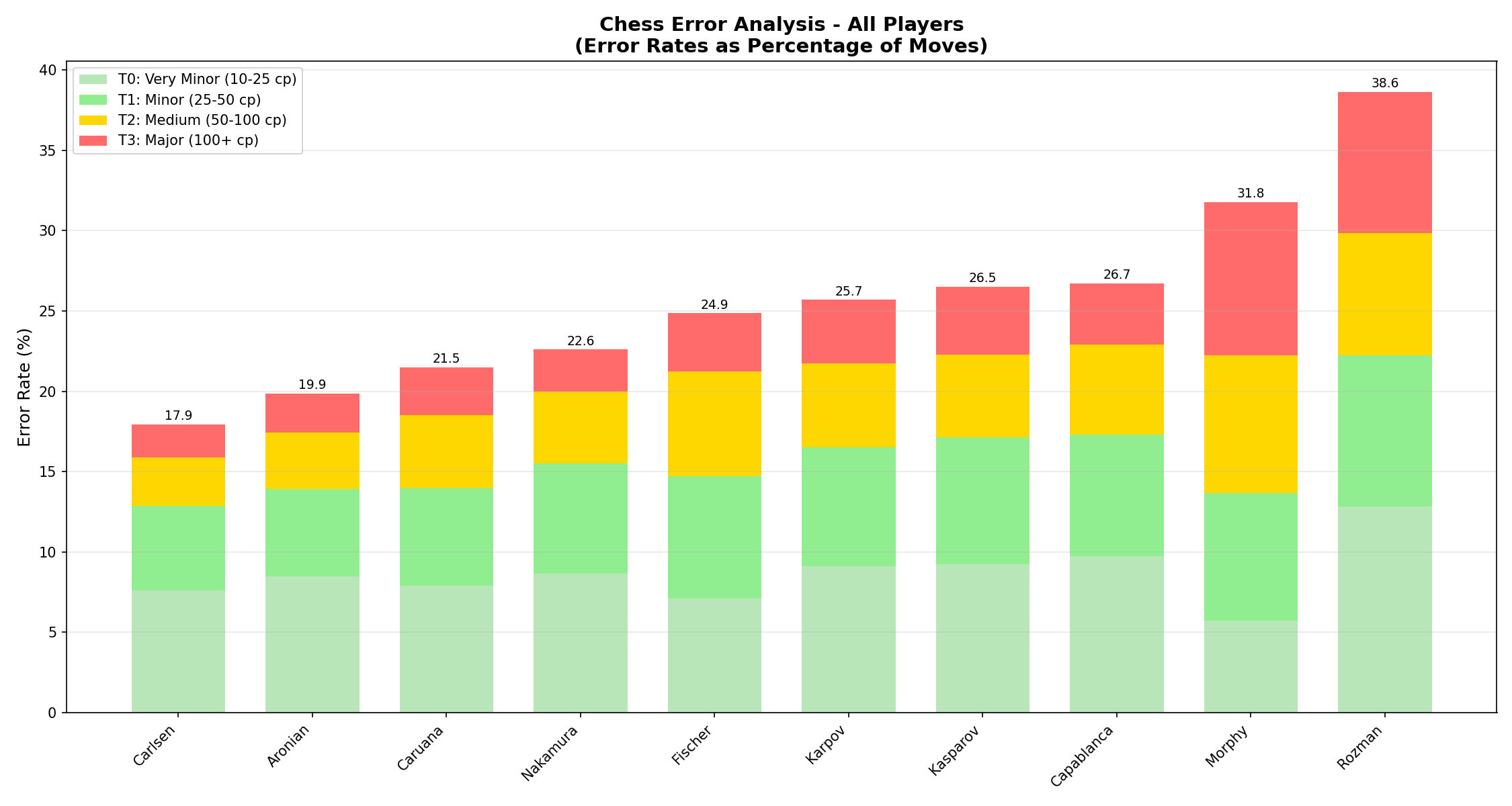
Total error rates across all players, broken down by severity tier. Lower is better.
To validate that these results aren't an artifact of game phase (perhaps modern players simply trade pieces faster), we also stratified the analysis by piece count. The table below shows error rates across all phases:
| Player | Total Error Rate | High Pieces (>22) | Mid Pieces (16-22) | Low Pieces (<16) |
|---|---|---|---|---|
| Carlsen | 17.9% | 21.4% | 17.9% | 11.4% |
| Aronian | 19.9% | 22.3% | 19.7% | 14.6% |
| Caruana | 21.5% | 25.1% | 21.1% | 13.2% |
| Nakamura | 22.6% | 26.1% | 21.8% | 13.7% |
| Fischer | 24.9% | 28.8% | 23.0% | 19.1% |
| Karpov | 25.7% | 28.7% | 25.2% | 17.6% |
| Kasparov | 26.5% | 30.0% | 25.6% | 16.8% |
| Capablanca | 26.7% | 30.3% | 24.0% | 20.9% |
| Morphy | 31.8% | 36.2% | 28.1% | 24.6% |
| Rozman | 38.6% | 41.1% | 39.7% | 29.7% |
The rankings hold remarkably consistent across all game phases, suggesting the overall error rates reflect genuine differences in accuracy rather than stylistic artifacts.
Could Levy Beat Morphy?
Let's start with a question that might seem straightforward: How would a popular modern streamer and International Master fare against a 19th-century legend?
The numbers tell an interesting story. Despite playing over 150 years ago with no databases, no engines, and no endgame tablebases, Morphy achieved a 31.8% total error rate compared to Levy's 38.6%. This gap holds across all game phases: Morphy was more accurate in complex positions (36.2% vs 41.1%), middlegame positions (28.1% vs 39.7%), and simplified positions (24.6% vs 29.7%).
Bobby Fischer once called Morphy "perhaps the most accurate player who ever lived." While our data shows Morphy at 31.8%, far from the most accurate by modern measurement, Fischer's admiration makes sense in context. Morphy achieved this level of play entirely through natural talent and study of limited existing games. He had no opening theory to memorize, no engines to check his analysis, no databases of master games to study. Given these constraints, his accuracy was extraordinary for his era.
The fact that he played at what appears to be strong IM strength (various estimates place him around 2400-2600 in modern terms; Elo himself suggested 2690) is remarkable given his resources.
Based on the data, Morphy would likely have been quite competitive against Levy, and perhaps favored. The numbers suggest his chess understanding was genuinely deep, not merely a product of weak opposition.
Could Hikaru Beat Capablanca?
Now for the claim that sparked this analysis. Hikaru shows 22.6% total errors compared to Capablanca's 26.7%, a meaningful 4-point gap. Fabi is even more accurate at 21.5%. On the surface, this supports their confidence.
But here's where it gets interesting. Look at the clustering in our data:
- Capablanca: 26.7% total errors, 3.8% major blunders (T3)
- Kasparov: 26.5% total errors, 4.2% major blunders (T3)
Capablanca and Kasparov are statistically nearly identical, and Capablanca actually committed fewer major blunders. Most historical rankings place Kasparov among the top 2-3 players of all time, and the idea of an "easy" match against peak Kasparov would surprise many observers.
This finding aligns with prior research. The famous Guid & Bratko study (2006), which analyzed World Champions using computer evaluation, found Capablanca emerged as the top scorer by average deviation from computer-recommended moves. The researchers noted, however, that his outstanding score "should be interpreted in the light of his playing style that tended towards low complexity positions."
What makes Capablanca's accuracy remarkable is the context: he achieved parity with Kasparov while having zero technological assistance. No opening databases. No engine preparation. No endgame tablebases. This suggests extraordinary natural talent, the kind that might not be fully captured by error rate alone.
The accuracy gap between modern elites and Capablanca is real. Whether that gap translates to decisive match outcomes is a different question entirely.
Why Modern Accuracy May Come Easier
Before concluding that modern players are simply "better," we should consider what the numbers might be hiding.
First, there's the matter of opening choices. Our analysis of pawn structure evolution shows that Sicilian Defense usage dropped from 32.5% of elite games in the 1970s to just 18.5% in the 2020s. Modern players increasingly favor the French Defense, Carlsbad structures, and other strategically safer lines. The same error rate achieved in a sharp Sicilian Najdorf represents a different level of skill than the same rate in a Berlin endgame.
Second, consider competitive incentives. Fischer and Kasparov needed to win games to dominate their eras. They faced opponents who would take risks to beat them, and they had to take risks themselves to maintain their reputations. Modern elite players ranked #2-5 can often maintain their standing through solid, drawish play. When you're not constantly fighting for wins in unbalanced positions, your error rate naturally improves.
FiveThirtyEight's analysis of all 1,034 World Championship games found that accuracy has been steadily increasing over decades, with the 2021 Carlsen-Nepomniachtchi match being "the most accurate championship ever played." This is partly better chess, but it's also partly different chess.
What We Can Conclude
The data supports several conclusions:
Chess accuracy has measurably improved over time. Modern elite players make fewer errors than historical champions when measured by engine evaluation. This is real and meaningful progress.
The improvement may be partially structural. Changes in opening theory, competitive incentives, and preparation methods have made high-accuracy play more achievable, though this doesn't diminish the skill required to execute it.
Error rate alone doesn't fully capture chess strength. Capablanca matching Kasparov's accuracy with no technology, or Fischer's admiration for Morphy despite measurable error rates, suggests that dominance involves more than avoiding centipawn loss.
As for Hikaru and Fabi's claims: the accuracy gap they'd hold over historical players is real. A 4-5 percentage point difference in error rate is meaningful. But "not super competitive"? The data, and the Capablanca-Kasparov parity, suggest that's probably overstated. Historical champions achieved remarkable accuracy under far more difficult conditions, and the qualities that made them dominant may not be fully captured by the metrics we can measure today.
Methodology
Approximately 200 classical games were selected for each player from their most prolific competitive periods. Games were analyzed using Stockfish at depth 25, evaluating moves 11-50 to exclude opening preparation and deep endgames. Error tiers were defined as: T0 (10-25 centipawns), T1 (25-50cp), T2 (50-100cp), T3 (100+cp). Stratified analysis by piece count (High: >22, Medium: 16-22, Low: <16) was performed to validate consistency across game phases.