Online Chess Has an Abandonment Problem
I started playing chess in the late 90s as a member of my high school chess club, founded by a friend of mine who would go on to become an expert and win the Virginia high school championship. I got very invested in it, buying books like Modern Chess Openings and classics by the old Masters. My friend and I would go to tournaments and even out-of-state competitions, such as US Nationals. And every Tuesday, an informal gathering of five or six people – mostly elderly gentlemen – would meet at the local library and huddle over the chessboards. One thing all those games had in common is they would end with a ritual of a handshake and an acknowledgment of “good game.” Anything else would be a breach of chess etiquette.
When I first started playing chess online, the two platforms I used were Yahoo! Chess and Internet Chess Club (ICC). Now I could test myself against real opponents over dial-up, not having to wait for the next in-person gathering. Chatting with opponents was good-natured and friendly, and a couple memories still stand out to me:
- An opponent on Yahoo! Chess had the username khadevis_robinson. As a collegiate runner, I knew the name Khadevis Robinson to be an Olympian and multiple-time USA champion in the 800 meters. I asked if it was him, he said it was, and we chatted about running for a bit between games.
- During my freshman year of university, I was chatting with an opponent on ICC, and it turned out that not only were we attending the same school, but we sat right next to each other in Game Theory class. That was a pretty crazy one.
I also ended up connecting over ICC and becoming friends with several people who I would hang out with at tournaments.
Measuring the Problem
Online chess typically has a time control, which is a fixed period of time you have to make all your moves in the game. Three, five, and ten minute games are among the most popular time controls in chess. The game ends when one player runs out of time, resigns, wins by checkmate, or if a draw is agreed.
But what happens if your opponent decides to just walk away from the game on their phone or computer? While instances of in-person abandonment have been known to happen (some funny anecdotes, but I won’t get into them now), abandonment has become an ugly feature of online chess that players have to tolerate. While cheating with engine assistance has gotten plenty of headlines in recent years, and sites like Chess.com do a good job detecting and punishing identified cheaters, the abandonment problem has not received the attention it merits.
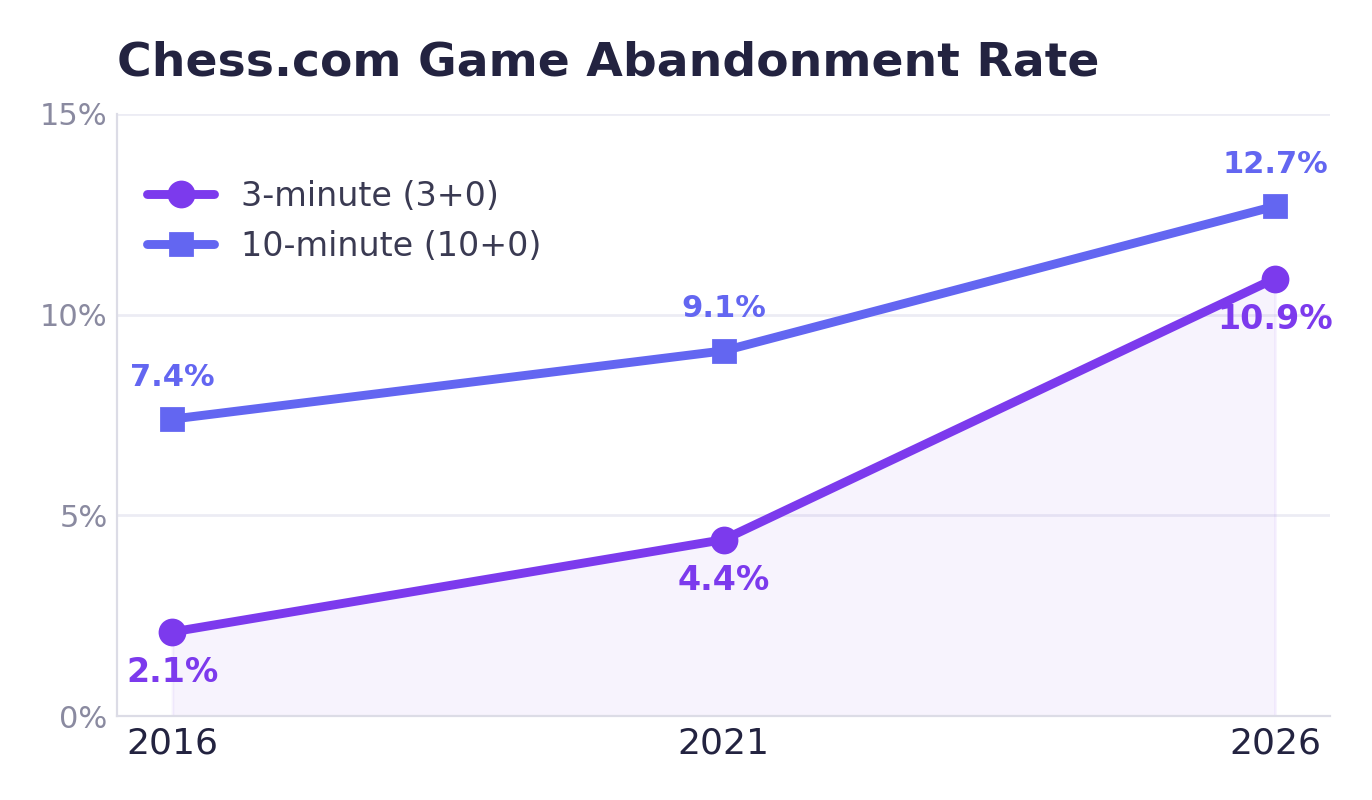
In order to see how abandonment rates have changed over time, I looked at a randomized sample of 10,000 games from 2016, 2021, and 2026 for both 3 and 10-minute games played on Chess.com, which is by far the largest arena for online chess. The results show how much has changed in chess behavioral norms over the past ten, and even five years.
| Time control | 2016 | 2021 | 2026 |
|---|---|---|---|
| 3-minute (3+0) | 2.1% | 4.4% | 10.9% |
| 10-minute (10+0) | 7.4% | 9.1% | 12.7% |
Share of games ending in abandonment, Chess.com (n = 10,000 per cell).
Now, not all abandonments are intentional, as sometimes there are connection issues or something urgent comes up. The following table shows that players do abandon games in winning or balanced positions. But we can state with a high degree of confidence that today, most abandonments on Chess.com are intentional – commonly called “rage-quitting” – as the abandonments in losing positions dwarf those in winning positions.
| Year | Time control | Winning | Balanced | Losing |
|---|---|---|---|---|
| 2016 | 3-min | 5.8% | 57.8% | 36.4% |
| 2016 | 10-min | 10.8% | 47.2% | 42.0% |
| 2021 | 3-min | 7.1% | 40.0% | 53.0% |
| 2021 | 10-min | 9.9% | 26.8% | 63.2% |
| 2026 | 3-min | 8.5% | 25.6% | 65.9% |
| 2026 | 10-min | 9.4% | 24.2% | 66.4% |
The position from the abandoner’s perspective at the moment they left, by engine evaluation (“losing” = down 3+ pawns). Not only do losing positions dominate, that dominance has grown sharply over time.
The Death of the Social Contract
So, what is happening that explains the rapidly-growing abandonment rate?
Before the internet, a game of chess involved a social contract and certain rules of etiquette. Acknowledging a game well played with a handshake was required, and getting up and walking away from a losing position would carry a social cost of shameful behavior. In the early days of online chess, such mores largely carried over from over-the-board (OTB) behavior, as most online players had learned the game through OTB play, and instances of abandonment were few and far between.
Additionally, the online chess communities such as ICC were smaller and closer-knit, with personal identity tied to your online chess account. And you would likely encounter the same opponents on repeat occasions, leading to reputation effects for any unsporting behavior.
What makes someone want to rage-quit? Is it a desire to punish the opponent for trying their hardest and winning the game? Apathy about wasting someone else’s time? Inability to acknowledge defeat and move on? Whatever the motivation, the social structure around online chess fails to stigmatize or deter this behavior the way it did in the past.
Perhaps the growth in rage-quitting simply reflects changes in a broader societal attitude toward interpersonal interactions, driven by a mentality that sees chess as a “video game” rather than a friendly contest between two human adversaries. The size of the player pool on Chess.com at all but the highest levels means that your opponents are effectively anonymous – just a username – and to some extent dehumanized. You click “next game” and move on, and such one-shot games are a textbook setup for behavioral defection.
Who Are the Serial Abandoners?
So, who are these serial abandoners, and what can be done to prevent such behavior, which is not only rude but also wastes others’ time?
Not surprisingly, our analysis shows that there are several attributes impacting the likelihood that a player will abandon games.
- Account age: Accounts created in 2022 or later show a 13.9% abandonment rate, compared to 10.6% for pre-2020 accounts.
- Paid membership: Paid Chess.com members abandon at 9.2% versus 13.6% for free accounts.
- Number of friends/followers is also highly predictive: 0 followers 15.4% → 1–9 13.0% → 10–49 11.9% → 50+ just 6.9%.
- Anonymity: No location shown 13.5% vs 8.5%; no avatar 14.3% vs 11.6%.
- Rating: ~13% at under-1000 vs ~2% at 2000+. However, “influx of beginners” cannot be the full explanation, as the 1000–1500 and 1500–2000 cohorts (fairly strong, serious players) showed a rate of 9–10%.
The bottom line is that players who invest more in chess and affiliate their personal identity with their online persona are less likely to abandon games.
Country affiliation was also a strong differentiator; however, there are significant differences in connection quality globally. Nevertheless, we can consider the ratio of abandonments in winning against losing positions to estimate how many were likely intentional. The “best” country was Great Britain at only 6.4%, while the US made the top-5 worst with 14.2%, despite having a much higher than baseline rate of intentional abandonments. Other bottom countries were likely at least somewhat impacted by internet quality. Not something to be proud of, my fellow Americans.
Enforcement and Deterrence
If someone consistently abandons games, are there any repercussions? Chess.com policy states that “we do not tolerate [stalling/abandoning] on our site” and that there is a warning message that you have to click to acknowledge before you can keep playing.
However, in spite of the anti-abandonment policy, the data show that the Chess.com abandonment problem has continued to get worse. We don’t know the extent to which a 5-minute timeout or other sanctions are actually enforced, but it clearly does not seem to properly deter serial abandoners.
The second-most popular online chess platform, Lichess, allows players to claim a win or a draw if the opponent disconnects (abandons). Therefore, the comparisons are not quite apples-to-apples, but the Lichess abandonment rates rose only modestly from 1.6% to 1.9% in 3-minute, and 2.3% to 2.5% in 10-minute games from 2021 to 2026.
Lichess also stipulates a strict anti-abandonment policy:
What is done about players leaving games without resigning?
If your opponent frequently aborts/leaves games, they get “play banned”, which means they're temporarily banned from playing games. This is not publicly indicated on their profile. If this behaviour continues, the length of the playban increases - and prolonged behaviour of this nature may lead to account closure.
While there could be some self-selection effects between the player cohorts on each platform, it does appear that Lichess’ enforcement of such behavior has been much more effective in deterring abandonments than that of Chess.com.
Conclusion
The sharp rise in abandoning online chess games in recent years has become an unfortunate symptom of the anonymization and loss of humanization in the Internet era that affects not only chess, but society as a whole. But we can also see that tying personal identity to online accounts, even through avatars or listing your location, does somewhat mitigate this behavior.
What a community tolerates becomes the norm, and what it enforces becomes its culture. The vanishing opponent has become a small cruelty that online chess enthusiasts have had to tolerate, but these small cruelties that we accept online reshape how we treat each other. I, for one, would hope that more stringent enforcement policies will eventually force abandoners to reexamine their motivations and behavior in the world of online chess and beyond.